
You don’t need a laboratory, a science degree, or expensive equipment to nurture your child’s interest in science. What you need is curiosity — and the willingness to say “I don’t know, let’s find out” when your child asks a question you can’t answer. We spoke to primary school science coordinators, home educators, and parents across the UK to compile the most effective strategies for sparking and sustaining scientific interest at home.
Start with Questions, Not Answers
The single most effective thing you can do is model curiosity. When you’re walking to school and your child asks why puddles disappear, resist the urge to immediately explain evaporation. Instead, ask them what they think happens. Where does the water go? Could you test your idea?
This shift — from providing answers to exploring questions — is the foundation of scientific thinking. Children who learn to ask “I wonder why…” and “What would happen if…” are developing the same habits of mind that professional scientists use every day.
Make the Kitchen Your Laboratory
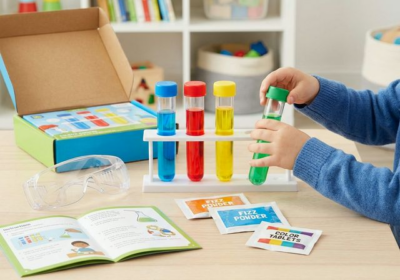
Cooking is science in disguise, and your kitchen is already fully equipped. Here are some activities that teach real science concepts:
- Bread making — demonstrates how yeast (a living organism) produces carbon dioxide gas. Children can experiment with different temperatures to see how warmth affects rising speed.
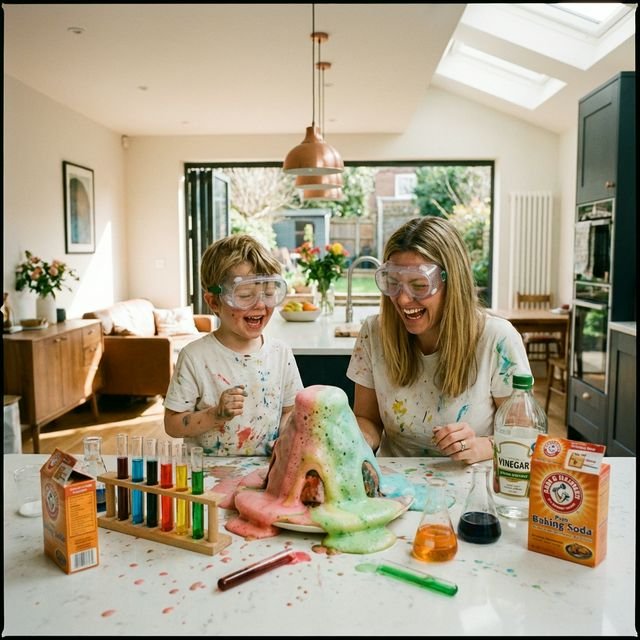
- Vinegar and baking soda reactions — the classic “volcano” teaches acid-base chemistry. Challenge children to predict what happens if you change the quantities.
- Dissolving experiments — which substances dissolve in water? Try sugar, salt, sand, oil, flour. Record results in a simple table. This introduces the scientific method naturally.
- Freezing experiments — does salt water freeze at the same temperature as fresh water? Why do we put salt on icy roads?
The beauty of kitchen science is that it uses materials you already have, requires minimal cleanup (relatively speaking), and produces visible, immediate results that satisfy children’s need for instant feedback.
Take Science Outdoors
Nature is the greatest science teacher available, and it’s completely free. Simple outdoor activities that develop scientific skills include:
- Nature journalling — sketch and label plants, insects, or birds in a notebook. This teaches observation and documentation.
- Weather tracking — record temperature, rainfall, and cloud types daily for a month. Look for patterns. This introduces data collection and analysis.
- Bug hunts — how many different insects can you find in your garden? Where do they prefer to live? This teaches classification and habitat awareness.
- Rock collecting — gather interesting rocks and try to identify them. Are they smooth or rough? Heavy or light? Do they have layers?
Invest in One Good Tool
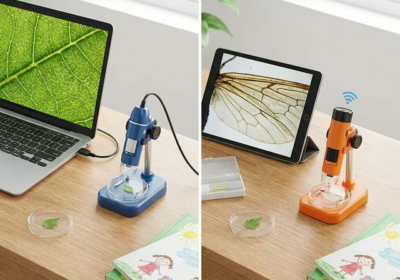
You don’t need a cupboard full of science equipment, but having one good tool can transform casual observation into genuine investigation. A pocket microscope (like the Carson MicroBrite Plus, under £20) turns every walk into a field trip. A simple magnifying glass can absorb a child for hours. A basic thermometer turns weather chat into data science.
The key is choosing a tool that’s robust enough for regular handling, simple enough for independent use, and versatile enough to remain interesting over time.
Follow Their Lead
Perhaps the most important principle is to follow your child’s interests rather than imposing your own. If they’re fascinated by dinosaurs, lean into palaeontology. If they love animals, explore biology and ecology. If they’re obsessed with space, study astronomy together.
Science isn’t a single subject — it’s a way of understanding the world. Whatever your child is passionate about, there’s a scientific angle waiting to be explored.
Screen Time Can Be Science Time
Not all screen time is equal. Some excellent resources for science-curious children include:
- BBC Bitesize — free, curriculum-aligned science content for all primary ages
- National Geographic Kids — stunning photography and accessible science writing
- Scratch (MIT) — free visual programming that teaches coding through creative projects
- YouTube channels like Mark Rober, SmarterEveryDay, and Maddie Moate — engaging, safe science content
What Not to Do
Finally, a few common mistakes that can inadvertently kill a child’s interest in science:
- Don’t make it feel like homework. The moment science becomes an obligation, it loses its magic.
- Don’t worry about getting things wrong. Failed experiments teach more than successful ones.
- Don’t over-explain. A three-minute explanation of photosynthesis to a five-year-old who asked “why are leaves green?” will kill the conversation. Keep it simple, keep it curious.
- Don’t gender it. Science is for everyone. Full stop.
The children who grow up loving science are rarely the ones who had the most expensive equipment or the most structured lessons. They’re the ones whose parents said, “That’s a great question. Shall we find out together?”