
STEM toys are designed to be educational and engaging, but they often include components that require extra consideration — chemicals in science kits, small parts in electronics sets, batteries in robotic toys. Before you buy any STEM toy, here’s what every UK parent should check to ensure safety alongside learning.
Understanding Age Ratings
Age ratings on toys are legal safety classifications, not suggestions. In the UK, the most important marking is the “Not suitable for children under 36 months” warning (the 0–3 symbol), which indicates the product contains small parts that pose a choking hazard.
For STEM toys, manufacturers sometimes provide two age ranges: a safety age (the minimum age for safe use) and a play age (the age at which the child will engage meaningfully). Always respect the safety age, but use the play age as a guide rather than a rule — you know your child’s abilities better than any manufacturer.
Our rule of thumb: For science kits with chemicals, add one year to the manufacturer’s minimum age for unsupervised use. For electronics kits, the stated age is usually accurate. For building sets with small parts, the stated age is suitable for supervised play — add a year or two for independent play.
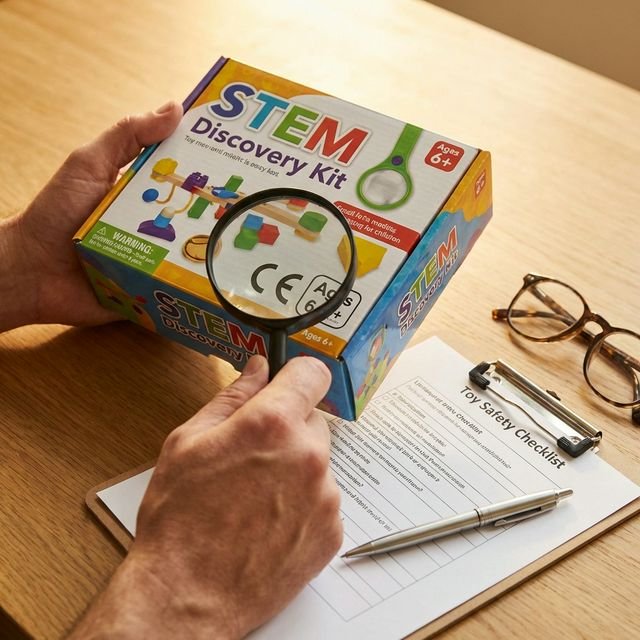
CE and UKCA Markings
Since Brexit, toys sold in the UK should carry the UKCA (UK Conformity Assessed) marking, though CE-marked products are still accepted during the transition period. Both markings indicate the product has been assessed against relevant safety standards.
What to watch for:
- Always check for CE or UKCA marking — its absence is a red flag
- Be cautious with marketplace sellers — products sold directly from overseas on Amazon Marketplace or eBay may not have been tested to UK standards
- The “CE” marking should be a specific design — the letters should be a particular size and spacing. Counterfeit products sometimes use a “China Export” marking that looks similar but has different letter spacing
Chemical Safety in Science Kits
Science kits often contain chemicals that are safe when used correctly but could cause harm if misused. Here’s what to check:
Read the safety data sheet. Reputable science kit manufacturers include safety information for every chemical in the kit. Review this before giving the kit to your child.
Common chemicals in children’s kits and their risks:
- Sodium bicarbonate (baking soda) — very safe, minimal risk
- Citric acid — safe for handling, mild skin irritant in concentrated form
- Plaster of Paris — safe when dry, but generates heat when mixed with water (can cause burns if applied to skin while setting)
- Crystal growing solutions — usually potassium aluminium sulphate or similar; safe with normal handling but should not be ingested
- pH indicators — generally safe but can stain skin and clothing
Our recommendation: Always supervise the first use of any science kit, regardless of the stated age range. Once you’re confident your child understands the safety procedures, you can gradually allow more independent use.
Battery Safety
Many STEM toys use batteries, and button cell batteries (the small, round, flat ones) are the most dangerous type. If swallowed, a button cell battery can cause serious internal burns within two hours.
Safety checks for battery-powered STEM toys:
- Battery compartments should be screw-secured — not just clip-closed — for any toy used by children under 7
- Check regularly for loose or corroded batteries — corrosion can cause batteries to leak harmful chemicals
- Keep spare batteries locked away — especially button cells
- Use rechargeable batteries where possible — they’re safer, cheaper long-term, and better for the environment
Magnets and Small Parts
Several popular STEM toys use strong magnets — Magna-Tiles, magnetic building sets, and magnetic science kits. Small, powerful magnets are extremely dangerous if swallowed, as they can attract through intestinal walls and cause life-threatening injury.
Fortunately, most reputable magnetic STEM toys encase their magnets within larger plastic components, making accidental ingestion virtually impossible. However:
- Check regularly for cracks or damage that could expose internal magnets
- Discard any pieces that are cracked or broken
- Keep magnetic toys designed for older children away from toddlers and babies
Online Purchases: Extra Caution Needed
When buying STEM toys online, especially from marketplace sellers:
- Read reviews carefully — look specifically for safety complaints
- Check the seller’s location — UK-based sellers with UK stock are generally safer than direct overseas shipping
- Be wary of dramatically low prices — if a product is significantly cheaper than competitors, corners may have been cut on safety testing
- Verify the brand exists — search for the manufacturer’s website and check they’re a real company
When Something Goes Wrong
If you have a safety concern about a STEM toy:
- Stop using the product immediately
- Report it to Trading Standards via the Citizens Advice consumer helpline (0808 223 1133)
- Report it on the government’s product safety reporting tool at gov.uk
- Contact the retailer for a refund — UK consumer law entitles you to a full refund for unsafe products
Safety shouldn’t discourage you from buying STEM toys — the vast majority are well-designed and thoroughly tested. But a few minutes of checking before you buy can give you confidence that your child’s learning experience will be both enriching and safe.