
Once your child has caught the microscope bug, it’s tempting to buy every accessory available. Prepared slide sets, specimen collection kits, carrying cases, adaptors — the list is endless. But which accessories actually enhance the experience, and which end up forgotten in a drawer? We’ve tested dozens of accessories over the past year to find out.
Worth Every Penny
Prepared Slide Sets (£8–£15)
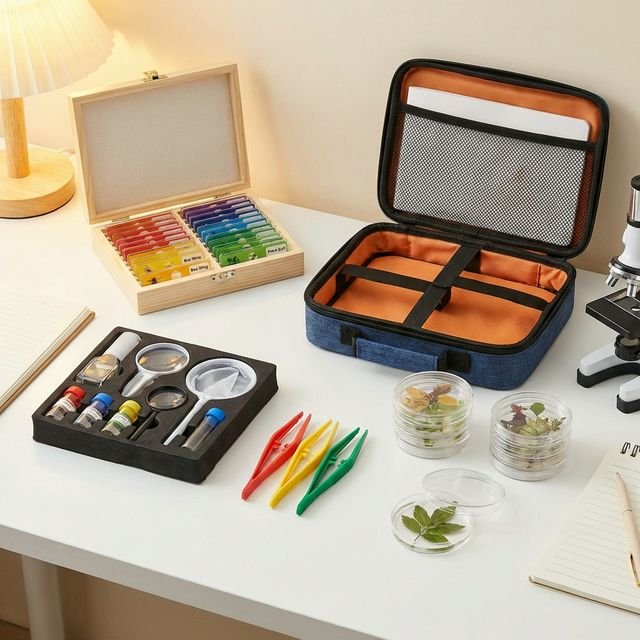
A good set of prepared slides is the single best accessory you can buy. These are pre-mounted specimens — plant cells, insect parts, animal tissues — that are ready to view immediately. They provide instant gratification while teaching children what to look for when preparing their own specimens later.
Our recommendation: the AmScope PS25 Prepared Slide Set (£12.99, 25 slides). It includes a diverse range of specimens with clear labels, and the quality is consistently good. Avoid the ultra-cheap sets from unknown brands — the specimens are often poorly prepared and the labels sometimes inaccurate.
Pro tip: Start with a set that covers different categories (plants, insects, textiles) rather than one focused on a single subject. Variety keeps interest alive.
Blank Slides and Cover Slips (£4–£8)
Essential for children who want to prepare their own specimens. A box of 50 blank slides with cover slips costs very little and opens up a world of DIY microscopy. Children can examine water samples, flower petals, food items, and anything else that sparks their curiosity.
Glass slides are better than plastic for image clarity, but plastic is safer for younger children (under 7). We recommend starting with plastic and moving to glass when children are old enough to handle them carefully.
Tweezers and Pipettes (£3–£6)
A pair of fine-point tweezers and a set of plastic pipettes might seem trivial, but they make a significant difference to the specimen preparation experience. Children can handle tiny specimens precisely and add precise drops of water — skills that translate directly into proper laboratory technique.
Look for tweezers with rounded tips for safety. Plastic pipettes are cheap, disposable, and far less frustrating than trying to use a teaspoon.
Nice to Have
Specimen Collection Kit (£10–£20)
These kits typically include collection jars, a magnifying glass, tweezers, and sometimes a field guide. They’re not essential — you can assemble the same items from things around the house — but they’re nicely packaged and motivating for children who like having “proper” equipment.
The National Geographic Outdoor Exploration Kit (£14.99) is our favourite. It’s well-made, includes a decent magnifying glass, and comes in a carry bag that children actually use.
Phone/Tablet Adaptors (£8–£15)
If you have an optical microscope (not digital), an adaptor that holds a phone or tablet camera over the eyepiece can transform it into a digital microscope. Results vary depending on alignment, but when it works well, it’s a clever way to capture and share images without buying a separate digital microscope.
These work best with tablets (larger screen, easier to align) and require patience to set up. Not ideal for children under 8 without adult help.
Save Your Money
Microscope “Experiment” Kits (£15–£30)
These kits promise exciting experiments like growing bacteria cultures or examining pond life. In practice, the experiments are often underwhelming, the included equipment is flimsy, and the instructional materials are vague. Your child will get more out of a good set of prepared slides and some blank slides than any of these kits.
Expensive Carrying Cases (£15–£25)
Unless you’re regularly transporting a full-sized tabletop microscope, a dedicated carrying case is unnecessary. Most handheld and USB microscopes are robust enough to toss in a bag, and a simple zip-lock bag provides adequate protection for pocket microscopes. Save the money for something more useful.
Staining Kits (£10–£20)
Biological staining kits (methylene blue, iodine, etc.) are used in professional microscopy to highlight cell structures. They sound impressive but are impractical for children. The stains are messy, potentially irritating to skin, and the technique requires precision that frustrates most children under 12. Wait until secondary school science covers this properly.
Our Recommended Starter Bundle
If you’re buying accessories for a child who’s just starting with microscopy, here’s what we’d recommend:
- Prepared slide set (25 slides) — £12.99
- Blank slides with covers (50 pack) — £5.99
- Fine tweezers + pipettes — £4.99
Total: under £25. This bundle gives your child everything they need to explore pre-made specimens and start creating their own. Add a specimen collection kit later if their interest grows.
The best microscope accessory, however, costs nothing at all: your time and enthusiasm. The children who stay engaged with microscopy longest are invariably the ones whose parents sit down and explore alongside them, asking questions and sharing in the wonder of the tiny world.